
Michele Loi
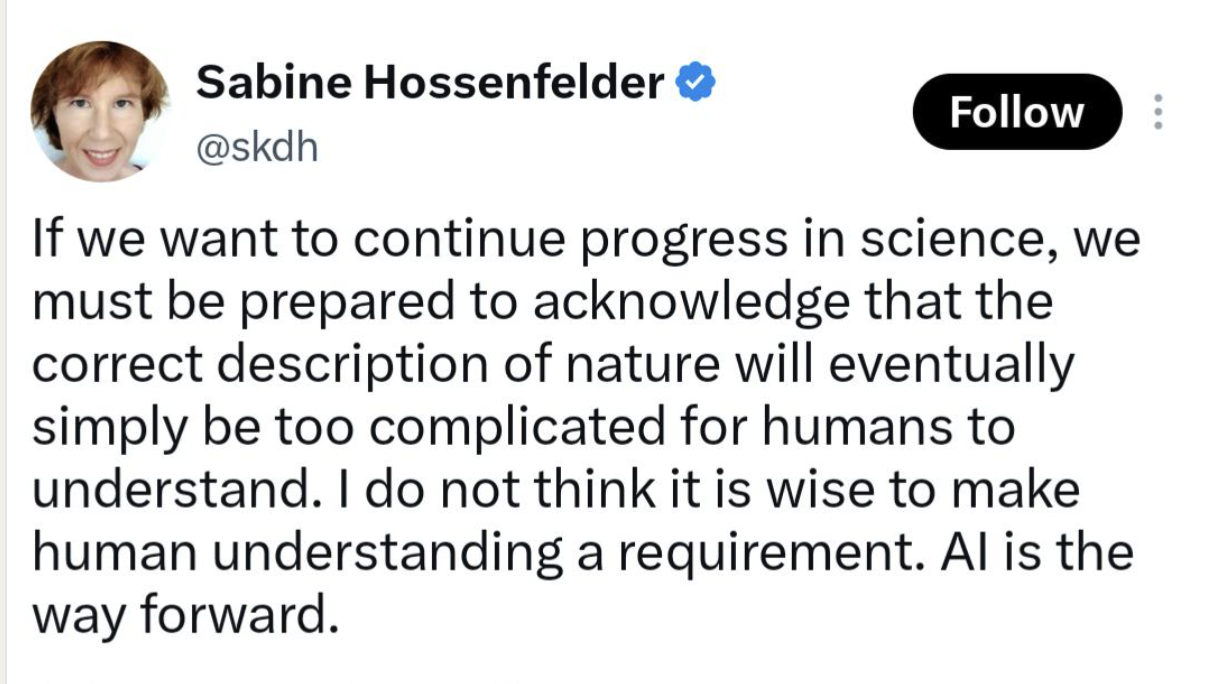
Sabine Hossenfelder (@skdh). Read the original post on X.
Sabine Hossenfelder’s post raises a question about the future of science: must successful explanations remain within human understanding? That possibility also invites a different question: what, if anything, would humanity’s loss of intellectual primacy mean for a worthwhile life?
Much of what passes for philosophical discussion of AI is narrow-minded and shallow. Its most persistent weakness is historical forgetfulness. We are invited to contemplate the collapse of human meaning by people who write as though the relationship between knowledge, reason, and a worthwhile life had never been seriously questioned before.
The discussion often attempts philosophical depth using little more than a poorly educated positivist common sense. Science tells us what reality is; understanding reality tells us who we are; therefore, losing our position as reality’s privileged interpreters threatens the foundations of our existence. Each step needs an argument. Familiarity has allowed the whole sequence to pass as obvious.
The forgetfulness extends even to positivism itself. Mach’s reflections on science were considerably more subtle than the common sense now borrowing its authority. And we are living after postmodernism’s sustained challenge to the idea that one authoritative system of knowledge can legitimate every other dimension of life. Agreement with that challenge is optional. Pretending it never happened is a poor starting point for philosophy.
We should have more resources than our predecessors for facing a transformation of our self-conception. We have their transformations to think with. The possibility of scientific intelligence exceeding human understanding belongs to a history that began long before computers. In one important respect, it may be less radical than changes we have already inherited.
Consider the passage from the Aristotelian world to the Galilean one.
In Aristotle’s natural philosophy, understanding a natural being involves understanding its form, its development, and the ends toward which its activities tend. Purpose belongs within the explanation of nature. That world was no simple projection of everyday common sense, but its explanatory vocabulary made room for familiar questions about what something is for.
Galileo’s declaration in The Assayer that nature is written in the language of mathematics announces a different demand. Nature becomes intelligible through mathematical relations that observation and experiment help establish. Familiar appearances lose their authority to dictate what an adequate explanation must look like.
This transformation extended far beyond Galileo and unfolded unevenly. Its philosophical consequence nevertheless deserves emphasis: successful knowledge of nature no longer has to disclose purposes in which we can recognize our own. A mathematically articulated world need offer no corresponding account of what makes a human life worthwhile.
The scientific revolution did not prove that life lacks meaning. It helped loosen a connection between natural explanation and meaningful order that had previously seemed much easier to sustain. An explanation could become more successful while the universe it described became less hospitable to our expectations.
Darwin brought that estrangement into our account of ourselves. Human beings belonged within the history of other living beings. Our capacities could be investigated as products of descent and modification. Their emergence did not require that humanity be the intended outcome of life.
Twentieth-century physics put further pressure on the expectation that reality must accommodate our familiar forms of comprehension. Relativity required revisions to everyday assumptions about space and time. Quantum mechanics demanded still more radical departures from familiar pictures.
The resulting theories make rigorous sense to trained scientists. Their difficulty is no licence to call them nonsense. But their mathematical intelligibility is quite different from the intuitive reassurance that the world works in ways we can readily picture. Learning the phrase “Schrödinger’s cat” scarcely closes that distance.
For most of us, much of our best science already comes through epistemic dependence. We rely on people who understand things we do not. We can acquire partial explanations, learn more, and assess the institutions involved, but the detailed theoretical understanding is usually elsewhere.
Such science can still inspire wonder and inform our lives. What it cannot do, merely by being authoritative, is provide an intelligible existential foundation that we ourselves do not understand. An answer whose significance remains inaccessible cannot orient my life simply because someone assures me that it is correct. It might as well be 42.
The sequence matters. First, natural explanation loosens its dependence on intrinsic purposes. Then our own existence becomes intelligible without being nature’s intended destination. Then the best explanations increasingly demand forms of thought remote from ordinary intuition. This is a selective history, but it reveals a consistent pressure: scientific success repeatedly exceeds the conditions under which we find a world familiar and reassuring.
At what point, then, did science acquire an exclusive responsibility for making sense of our existence?
Western philosophy contains a substantial history of refusing that responsibility. Hume showed how reasoning itself depends on dispositions and habits it cannot simply replace with demonstration. Kierkegaard insisted on the difference between detached knowledge and the task of existing as a particular person. Knowing about commitment does not perform the act of committing.
Wittgenstein sharpened the separation in proposition 6.52 of the Tractatus: “We feel that even if all possible scientific questions be answered, the problems of life have still not been touched at all.” The force of the thought depends on imagining science complete. Even then, something fundamental about living remains.
These philosophers disagree profoundly. They provide no single doctrine to adopt wholesale. They nevertheless give us resources for questioning the assumption that a comprehensive account of reality must supply an authoritative account of our purposes.
Postmodern thought intensified that questioning. Lyotard challenged the narratives through which knowledge claims comprehensive authority; his analysis concerned the changing status of knowledge in computerized societies. Rorty explored how solidarity and personal self-creation could proceed without ultimate philosophical foundations.
We need not accept every criticism of objectivity to take the consequence seriously. The authority of a scientific finding within an inquiry does not automatically make it the authority that should organize a life. Meaning also develops through relationships, histories, commitments, and practices whose significance cannot simply be read off a scientific theory.
Against this background, what is new about AI?
A sufficiently capable system might cross a boundary that previous science left intact. Today, when I fail to understand a theory, I can still say that someone understands it. The understanding belongs to a human community whose achievements I can regard as ours. An AI might produce results that we can test and use while their underlying explanatory structure exceeds every human capacity to grasp it.
That possibility remains a hypothesis. It would involve a genuine shift from my dependence on other human knowers to humanity’s dependence on a different kind of system. Even the reassurance that the scientists are “one of us” would become a question. What makes an intelligence part of our community: biological origin, participation in inquiry, mutual intelligibility, something else?
Yet this possibility can also be understood as a culmination of the Galilean separation between scientific success and familiar human intelligibility. Once success need not conform to our intuitions, there is a further question about whether it must remain within our capacities at all.
Nor does being surpassed imply that our own general capacities disappear. We might continue to inquire, understand, judge, create, and reconsider our lives while ceasing to occupy the highest available level of scientific intelligence. Losing a comparative position and losing a capacity are different events.
The distinction matters because existential questions have always been asked within limits. We have never occupied a position outside every limitation from which the worth of our lives could finally be certified. Our limits change; so do the forms our questions take. A particular pursuit may cease to be available. A proposed foundation may become untenable. The question of what is worthwhile survives those revisions.
Suppose we had invested our entire sense of worth in being the beings who could, in principle, comprehend everything. The collapse of that investment would require a serious reconsideration. It would also reveal how much we had asked a contingent intellectual position to carry. We would have discovered a need for revision, without thereby discovering that existence had become worthless.
What might such revision involve?
Each of us already has an orientation formed by our capacities and the particular course of our experience. That orientation makes certain possibilities matter before we can fully explain why. We search, sometimes find a place to rest, and sometimes discover that the rest was premature.
Reasoning helps us recognize tensions and respond to them. Encounters can do so too. An epiphany may begin a process whose significance becomes clear only through what follows. Understanding what we need can involve discontinuity, surprise, and changes we could not have selected from a menu in advance.
The distinction between a superficial orientation and a deeply internalized one concerns how we respond when its tensions emerge. A conviction may feel comfortable while leaving incompatible parts of our lives untouched. Greater depth can involve allowing those tensions to change us, even when the first result is a more difficult question.
There is no requirement that each step produce greater tranquillity. Discovering a deeper difficulty can be progress. Over time, however, we have reason to relinquish elements we cannot sustain together. Sometimes necessity makes that demand before we are ready. Embracing it allows an inquiry to continue.
This is the sense in which I would speak of our truer existential needs. They become clearer through processes in which we participate. Scientific knowledge can contribute to those processes; it cannot conduct them on our behalf. Neither can an authoritative answer whose grounds we are constitutionally unable to understand.
Our cultural age should count for something. We have had time to learn that an account of the universe can lose its authority to orient us without depriving us of every possible orientation.
If another change in our relation to knowledge arrives, we can meet it with that history behind us. We can ask what has actually been lost, which expectations have become untenable, and what remains available for a worthwhile life.
Those questions were meaningful before we could imagine answering them from outside our limits. They remain meaningful within the limits we discover next.